You searched for new era cap – Page 21 of 32 – The Martin Group
In just a week, we will officially kiss 2023 goodbye and say hello to 2024. But before you slam your laptops shut, eat your body weight in cookies, and scroll TikTok for hours on end, we have some final insights for you.
We’ve already covered creative, but as an integrated communications firm, we’re looking at an even grander picture in 2024, one that includes operational trends in social media, public relations, digital marketing, and paid media. Each year, the world of marketing and communications gets bigger and we want you to be prepared, so that’s why we did the work for you.
Here are the top trends you should look out for in 2024:
Video content will continue to dominate
It’s official. Video content is the most engaging and performs the best across social channels, but there are two things in particular we’re looking for in 2024: authenticity and captions.
Authenticity has been a key for content for a few years now, but now, we know that over produced, highly edited videos and reels are officially a thing of the past. Brands are focusing on the real people behind the advertisements rather than trying to portray the perfect image that only exists in an online fantasy.
As for captions, they’ve now become critical. Ifyou don’t have the closed captioning on your videos, you’re a big step behind the rest of us. Creators and brands alike are using videos for everything, but the amount of users watching videos without sound is bound to increase. And while most of us might just do this when we can’t find our earbuds, keeping captions on also helps increase the chance your content will be discovered using a keyword search.
Humanize your brand
Things are changing every day in the communications industry. When it comes to public relations, consumers are looking for more human touch in the services they’re accessing. With the emergence of artificial intelligence (AI), we’ve seen things across communications shift at an accelerated rate. But while AI can be helpful and innovative, it lacks the human side of things. That’s where PR pros come in.
In 2024, we’re going to continue to see a push for brands and organizations to be more authentic. Taking a humanized approach with empathy and understanding allows you to connect with your audience at a deeper, more meaningful level. People are naturally drawn to honesty and vulnerability. Using this as a brand helps to build trust and credibility in the industry, while still maintaining relationships with your clients and consumers.
AI becomes more personal
Artificial Intelligence is one of the major trends across the board—but in the next year, we can expect to see the use of AI become more personal. We live in a digital world, and marketing trends are defining how we work. Consumers no longer want (or have the patience) to wait for responses from brands. With the use of chatbots, we’ve seen the rate of speed pick up and now are looking to them to become more conversational. To keep up with consumer satisfaction, brands are utilizing data to personalize the consumer experience. This approach is expected to lead to more seamless interactions with consumers and brands while driving higher levels of engagement.
Using media to differentiate your brand
We now find ourselves being bombarded by advertisements across all platforms. Advertising still remains the top method for monetization on social media and streaming services, and it proceeds to ramp up in other online locations. The major streaming players continue to offer services with advertisements at a lower price point, and Netflix recently reported that more than 25% of new users are choosing ad-supported plans.
Due to the sheer number of advertisements that exist, brands are focusing on other methods to help set them apart and break through the clutter. The use of different creative strategies can allow brands to stand out from their competitors by providing a more authentic experience without oversaturating their audience with too many different ads. As important as it is to have plenty of advertisements out there, we are going to see more brands investing in more quality over quantity placements.
Interested in how we can help you manage these changes throughout 2024 and beyond? Please feel free to drop us a line!
You searched for new era cap – Page 21 of 32 – The Martin Group
Remember when you actually had to show up in-person to a business to see if they offered the product or service you needed?
The idea seems antiquated, but this was the norm just over two decades ago. With the arrival of Google and other online search engines, this all changed—and allowed us to do our casual browsing and intentional purchasing from our most comfortable furniture. This is how we shop.
And for businesses and organizations trying to reach new customers, search engine marketing (SEM) is an essential way to do it.
SEM refers to the practice of improving how customers find your product or service on a search engine (like Google) through paid advertising. These search engines are how we look for every need that’s either essential or the result of curiosity, so it’s become a necessity that businesses are out there in this space to address these needs. If they are, they can be found, utilized, and eventually, find tremendous success for their products and services.
Now at the start of another holiday season, businesses of all sizes will look to maximize their online presence to garner maximum sales. According to a recent study released by digital marketing platform Constant Contact, more than half of U.S. small businesses earn more than 25% of their annual sales between now and New Year’s Eve.
That’s a big number, as well as a reason for SEM to be part of every business’s strategy. It may be too late to execute an impactful campaign for this holiday season, but whether in December or at the start of January 2024, what should you know about SEM and where can you start?
The Martin Group’s digital team has thoughts—and thankfully, plenty of actionable direction. Here are their suggestions.
Keywords are key to success
If you’re just becoming familiar with the benefits (and necessity) of SEM for small and large businesses alike, then understanding the importance of keywords is a great place to start. Establishing keywords—used in blogs, web articles, website copy, and more—to focus your SEM efforts starts with uncovering what words or phrases your desired customers are using to find what they want. Once established, you can use this language to match customers with your products or services. And these keywords are not just helpful for this realm of marketing; they can also inform your overall messaging, content strategy, and continuous inventory, based on customer interest.
One way to establish what keywords could work for you and your goals is to use a keyword planner, which can help build a strong keyword list for your campaigns or ongoing operations. And good news: Google has one.
Patience can pay off
Although we live in a seemingly instantaneous world—where everything can be found and/or purchased with a few clicks—SEM doesn’t work like that. According to the SEO/SEM-focused Uncommon Marketing Works, campaigns run via Google ads can take up to three months to mature and show significant results—and you may not learn that you’ve achieved your ultimate goals for up to six months. Will you see anything in the initial weeks of an SEM campaign? Absolutely—but anything shouldn’t be the aim.
Just like building a business and a customer base, garnering their consistent attention to your calls to action takes time. Work with your internal or external digital team, and be patient enough to let your campaign perform—and, ideally, peak.
Understand your budget—and when to increase it
Money spent on SEM efforts is not a whole lot different than money spent on other marketing efforts: the bigger the spend, the better the chance at making an impact. Seems easy enough, but figuring the spend into your overall marketing budget—and making it flexible, based on what you’re trying to accomplish—is essential to assuring the purpose of the spend.
Spending a nominal amount just to do it may not accomplish anything aside from wasting money that can be spent elsewhere. Instead, establishing an amount that can be adjusted based on market research, customer targeting, and testing different approaches (with varied keyword combinations) will give you the best chance at success.
Go where your competitors do not
Yes, we’ve referenced Google a lot throughout this post. The search engine has single-handedly changed the way we shop, live—and is now as much a verb as a noun. But note: It’s not the only place for businesses to solicit possible customers.
From Microsoft Bing to DuckDuckGo and other search engine options, businesses can find other bastions to execute their SEM campaigns—and to do it in places their competitors may not be utilizing. In the case of Bing specifically, the SE boasts a visual search tool to easier match customers to products based on imagery, can allow businesses to get more out of their use of their chosen keywords than Google, and most important for your budget, can provide SEM capabilities at a 70% lower rate than Google.
Looking for SEM help? Please feel free to drop us a line!
You searched for new era cap – Page 21 of 32 – The Martin Group
For anyone who doesn’t pay attention to American pop culture or sports, please allow us to fill you in on the absolute domination of Taylor Swift and Travis Kelce right now. After Kelce famously attempted to ask Taylor Swift on a date using her token friendship bracelets made popular by her record-breaking Eras Tour, the two have since formed a romantic connection that seems to have enamored our entire nation.
E! News
So, what’s the big deal?
The big deal is that Swift is now showing up to NFL games to support her new beau, and her mere presence is sending game ratings through the roof, drawing attention to the NFL from audiences it hasn’t reached previously. After Swift’s first appearance in Week 4, the NFL saw a 22% increase in viewership for the Kansas City Chiefs’ game, most of that increase coming from women and girls who are presumably fans of the pop icon. Following the jump from Week 4 to Week 5, the NFL saw viewership rise again in Week 6 at the Jets-Eagles game, drawing nearly 10 million more viewers than the NFL viewership average. As the NFL season continues to unfold, we can only expect these numbers will continue to remain strong and rising.
Ratings aren’t the only numbers going up since the Kelce/Swift relationship became public. Taylor Swift famously sold out venues across the country this summer, including the Chiefs’ very own Arrowhead Stadium. It might make a fan wonder, what’s harder to get – a ticket to a Taylor Swift concert, or a ticket to a Chiefs game? Chiefs fans pack their stadium every week the team is at home, but Swifties around the world are selling out stadiums left and right within mere minutes of sales going live. Based on how things are going right now, Chiefs’ fans might start experiencing that same effect. After Swift’s first appearance at the Chiefs game on Sept. 24, ticket sales on StubHub went up 175% in just three days.
Taylor Swift via Instagram
All of this poses two critical questions:
Will famous females be the key to helping the NFL unlock a new wave of audience expansion?
Will the viewership persist as long as the Kelce/Swift relationship does?
It certainly appears that way, simply based on the well-documented “Taylor Swift Effect” and the influence that women adjacent to the league have within their communities.
Women bringing their audiences to the NFL
Beyond Taylor Swift’s ties to the Chiefs tight end, other women in popular culture are drawing significant attention to the NFL as well. Take TikTok star Alix Earle, for example. Boasting nearly 6 million followers on her account and nearly 100 times the number of likes, Earle’s famous GRWM (get ready with me) videos have gained traction that is nearly unmatched.
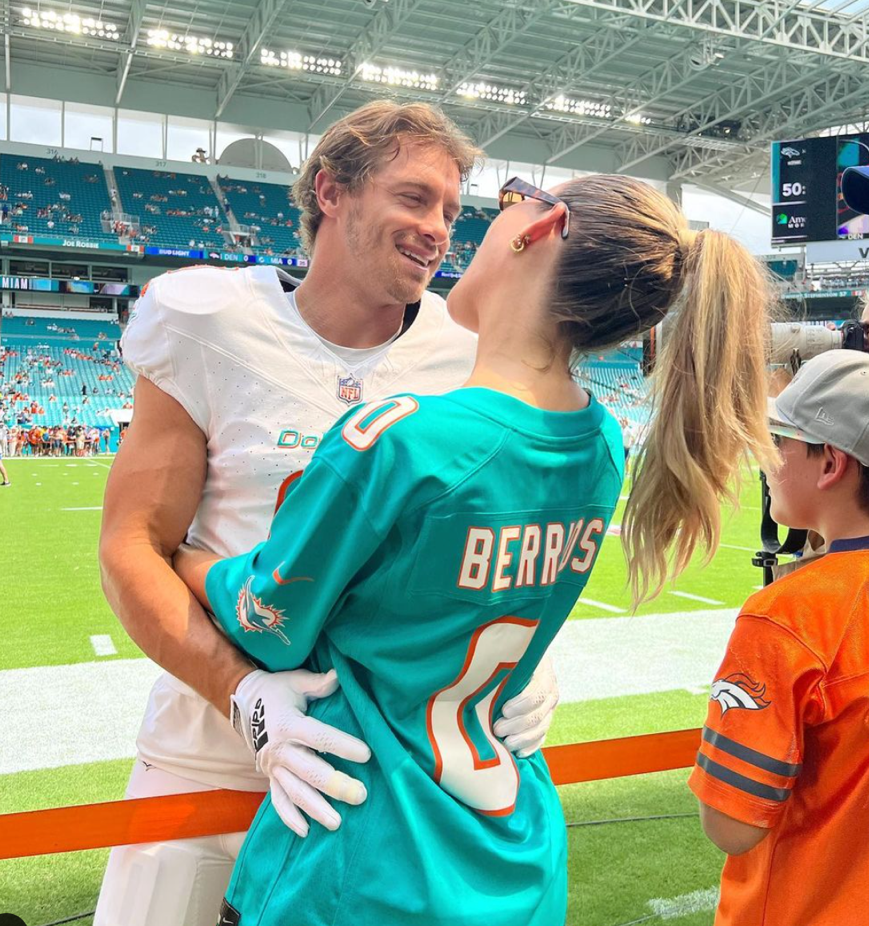
By allowing followers to “get ready with her” for the games of her boyfriend, Dolphins wide receiver Braxton Barrios, Earle has become an unofficial brand ambassador to the Dolphins’ organization. Her chats to her loyal following about the energy of the games – all while dressing head to toe in teal and orange – have caught the attention of millions, including recognition from the Dolphins organization itself, which responded to a recent video calling Earle “Our Barbie.”
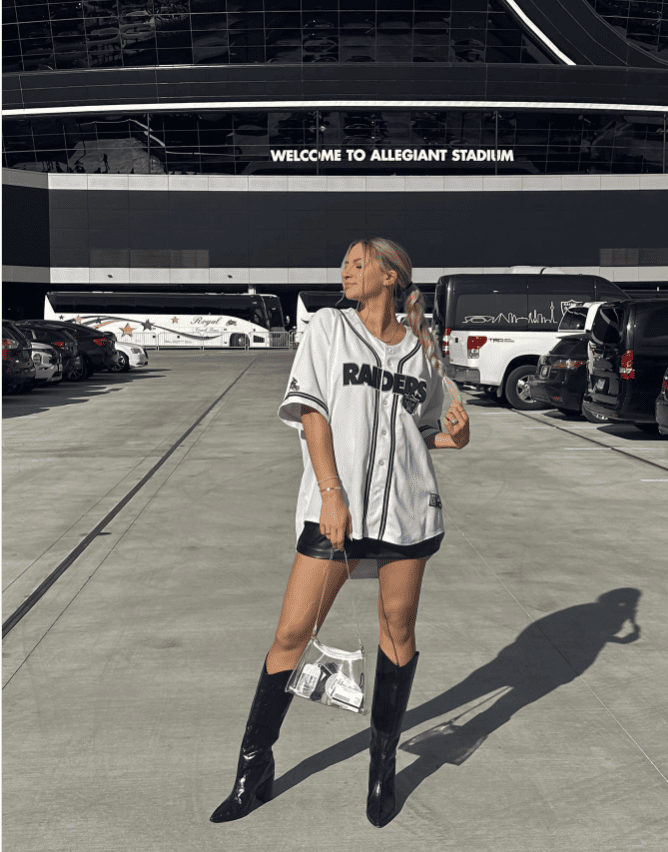
Now, we can’t recognize the greatness of Taylor Swift and Alix Earle without paying homage to an NFL spouse who has been making waves for years – Allison Kuch. As the wife of NFL defensive end Isaac Rochell, Kuch represents an entire group of women living sports-adjacent lives. Rochell most recently played for the the Raiders, but throughout their relationship, the pair has lived in multiple cities while growing together through the NFL experience. From trades to free agencies and everything in between, this couple has documented the ups and downs of their NFL journey on their respective Instagram and TikTok channels. To top it all off, they are currently expecting their first baby – with the due date smack dab in the middle of football season.
Alison Kuch via Instagram
Kuch first made her social media debut on TikTok and quickly became one of the most well-known creators in the space. Her TikTok following now consists of 2.8M of her own loyal fans tuning in to see what the two are up to. Fans love her authenticity and vulnerability surrounding her atypical life. She is known for mocking the trolls while celebrating her followers who recognize that she is the real star of the show in her relationship.
The spark — and lasting impact — of the women growing sports audiences
By simply being themselves, these three women have become a PR dream for football. Ratings, sales and followers are up across the board — and show no signs of slowing down. Case in point, Travis Kelce jersey sales alone are up 400% since Taylor’s first spotting.
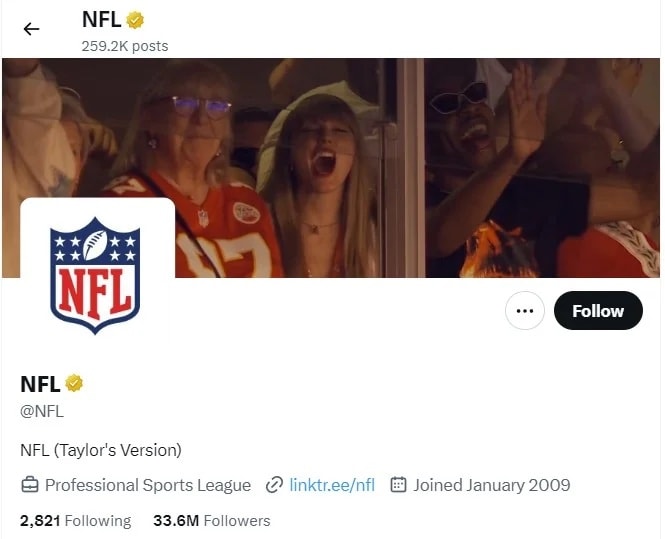
via X
The NFL has smartly hopped into these viral moments, changing its X bio to read “NFL (Taylor’s Version)” and dedicating posts to her attendance at the game. Not to mention the many ways TV networks, streaming channels and other media have capitalized on the opportunity with announcers and gameday pundits celebrating — and sometimes joking about — Swift’s NFL influence each week.
Fans and followers of Swift, Earle and Kuch — as well as other women tastemakers and trend-setters — are now tuning into games more than ever before. This is expanding the league’s reach beyond its traditional audience and inviting more people than ever before into this nationwide cultural phenomenon.
The power and influence they hold is truly remarkable, proving the massive impact a woman’s touch can have on the pro football experience. And the timing couldn’t be better with the explosive popularity of flag football. Millions of young women around the world are now playing flag, which was recently added to the 2028 Olympics and is becoming more widely available as a girls’ varsity sport in the U.S.
From the perspective of two Swifties who were NFL fans long before Taylor attended her first Chiefs game, all professional leagues should look for more ways to encourage prominent women to make their mark.
You searched for new era cap – Page 21 of 32 – The Martin Group
Creating the perfect canvas for pushing boundaries
Situation
Over the last few years, PUMA’s growing presence—and success—within Foot Locker has led to more opportunities for the international brand. With this came a more focused, long-term approach to elevating the brand’s presence within Foot Locker’s family of brands—including Kids Foot Locker, Champs, Eastbay, and Foot Action—that connects with their highly sought-after target audience.
When developing a progressive, over-arching strategy for PUMA’s Spring/Summer and Autumn/Winter collections, The Martin Group was tasked with providing creative concepts and visual direction, and adapting the initiative to speak directly to Foot Locker’s customer muses.
Solution
One of PUMA’s defining qualities is their ability to use color in unique ways. This core trait ultimately led to the development of the “Color Outside the Lines” thematic concept centered around new seasonal product drops. And while colors—and the inspirations behind them—are what would bring these product stories to life, there was much more to the thematic than the shoes and apparel themselves. Through the initial brief, our client was able to provide detail into the role color plays in their overall brand story. Mainly, how it is a connective thread that brings together cultural moments and causes, reflects emotion and self-expression, and is never static as it continues to evolve.
The Martin Group worked to clearly articulate how the concept “Color Outside the Lines” would manifest itself tactically and connect emotionally to the specific audiences Foot Locker’s brands are looking to attract.
After thoroughly digesting the brand values, tone, and personality, we explored each customer muse—their interests, tastes, and desires—and generated both an overarching manifesto along with individual messaging that authentically connected the celebration of color to the muses.
Through that exploration, we developed visual concepts that captured the campaign positioning and personality, but would also provide space to explore the many unique product drops throughout each season and align with PUMA’s team of brand ambassadors.
Results
While presenting several on-strategy creative concepts, the PUMA team felt that multiple options could be executed over the lifespan of “Color Outside the Lines.” Our team handled production of product photography, multiple still and video shoots with national ambassadors Cordae, ZaZa, and Young Dylan, and an in-store activation at a Champs location in Miami, Florida. The final deliverables were visible within Foot Locker stores around the country and across their social media platforms.
You searched for new era cap – Page 21 of 32 – The Martin Group
Home is more than a spot on a map. Ask any New Yorker — there’s a reason “where does upstate begin?” is hotly debated. It’s the same reason Buffalonians will correct anyone who dares say they’re upstate. (They’re in Western New York, thank you very much.)
It’s because each geographic location — a person’s original or adopted home — has personality. Unique characteristics. Differences. Things that inspire pride. Things that bring about challenges.
Recently, The Martin Group partnered with the International Center of the Capital Region to host separate delegations from North Macedonia and Ethiopia — groups of government officials and businesspeople visiting America as part of the U.S. Department of State’s International Visitor Leadership Program.
We shared some best practices for communications and advocacy — tips that our visitors could apply back home. But along the way, we also learned that when it comes to public affairs and public relations, some takeaways are truly universal.
Making a Difference Starts with Listening
Our practitioners are first class. We’re providing strategic counsel to some of the most prestigious companies in the nation and navigating the largest issues in New York State.
Therefore, our knowledge can potentially be applied beyond the borders of the United States.
Before meeting with the North Macedonian and Ethiopian delegations, we planned out the topics we’d cover and the tips we’d bring to the table. And in each case, we pivoted toward completely different directions after hearing about the communications challenges of our guests.
The lesson? Great communication starts with listening. So does making a difference.
Remembering the Basics
The basics are still the basics. In our line of business, a communicator must develop a reputation as a consistent, reliable, and trustworthy source of information. Maintaining that reputation is just as important.
That’s priority No. 1 because reputation is the key — wherever you are — to generating interest in your company or cause, building relationships with journalists, and increasing support among your audiences.
Communicating Is Challenging
While our social, political, and cultural environments may be vastly different, some struggles remain the same.
Our team learned through discussions with each delegation that we all face similar challenges when communicating to key stakeholders and raising one’s public profile. Vocal opposition, untimely breaking news, forging relationships with key groups — the list goes on.
The work is hard and often, stakes are high.
Repeating Your Most Important Messages
Reputation is everything. (See what we did there?) Its foundation is a combination of trust and respect, both of which are critical in any business, but especially in public communications.
We advise our clients to continually repeat their most important messages. Don’t let up. But talking points won’t be heard if you’ve lost trust or respect among your customers, constituents, members of the media, government officials, or other stakeholder groups.
Keep your focus on reputation, starting with trust and respect. Build it. And rebuild it, if you have to.
Here’s the last and most important takeaway: No matter where you call home, we’re all global citizens.
The world’s community is strengthened by making connections and exchanging ideas. We all have so much to learn from each other. Let’s not shy away from those opportunities.
We all have the power to make a difference, whether it’s in our own backyards or across borders. The Martin Group is committed to partners like the International Center for the Capital Region that are making an impact — and giving us a chance to make one of our own.
You searched for new era cap – Page 21 of 32 – The Martin Group
Remember 2023? Neither do we—and that’s okay.
Before we know it, there’ll be a whole new year to celebrate and navigate anyway, with all the new things we’ll learn throughout the next breakneck-paced 12 months. Things are changing insanely fast these days, and that’s especially true on the side of creative services. Every year, each member of our talented staff utilizes the artistic expertise they’ve cultivated over their career, while also incorporating new developments to their artistic arsenal, all to better serve the needs of our clients.
Constant evolution makes for a fluid situation, but it makes these creative drivers adept at assessing an always fluctuating professional landscape—and to judge what trends may arrive in the coming year.
Here are a few of our staff predictions:
Visual design’s dance with augmented reality
Over the past year, the graphic design community and the media members who cover it—have marveled at the transformative impact augmented reality capabilities are already having on the creative industry. It’s provided a significant communicative tool in every professional’s inventive arsenal, allowing for a connection with consumers that once existed solely in our imaginations (or in Back to the Future 2). Next year, it’s sure to evolve even more—and open up explorative pathways once unforeseen.
Digital space ? Visual art
As new digital spaces evolve, many designers are making their creative decisions with the space in mind. But in doing so, what is being sacrificed aesthetically or creatively? Navigating this relationship between space and substance—and making sure one doesn’t suffocate the capabilities of the other—will be of increased importance in the coming year. Changes continue to happen so fast, but as our Creative team points out, professionals shouldn’t sacrifice vision or connection to the audience just to adhere to spatial trends. Creation is king, and should continue to rule the spaces it occupies.
What’s old is new again (again)
There’s nothing new about nostalgia marketing. Every recent era has had its time to shine decades after it passed, and modern times haven’t deviated from this trend. In a recent feature in Ad Age, [L]earned Media CEO Sam Zises acknowledged that, “Throughout all historic moments of economic uncertainty in America, we can notice an uptick in nostalgia—in turning toward comforts of the past, imaginary or real, for something stable to hold onto when the current environment feels unsteady.” Look for this to roll into next year, as many themes, images, and even font choices should continue to call back to familiar times—all while our technology surges toward the future.
Keeping up with AI
Finally, no Creative Trends 2024 piece would be complete without teasing the expected, expanded capabilities of artificial intelligence—but one problem: No one’s certain what’ll come next to transform the way we create. After the technology’s breakout year across various industries, there are so many ways it could go in 2024. Will generative AI transform the way we use Adobe Illustrator to create and edit images? Will complementary video capabilities become more mainstream with AI available on platforms like Lumen5—and when it comes to managing projects between teams, will AI-powered apps like Forecast become key to enabling more effective workflow? The only thing we know for sure is that it’ll be imperative for creatives to stay on top of all new developments.
Change is inevitable—so get ready for plenty in 2024.
Looking for creative help? Please feel free to drop us a line!
You searched for new era cap – Page 21 of 32 – The Martin Group
As the summer comes to an official close, our public relations and public affairs teams continue to make waves working alongside our clients to secure headlines for the meaningful work they’re doing in our communities. We’ve made new connections, sought out unique opportunities, and landed big wins.
From our very own office move to new community programs, back-to-school excitement, and so much in between, we have generated some amazing coverage that has reached audiences across the state and nation.
Check out below for some of our most recent headliners:
Our Capital Region operation has successfully relocated to a new 3,500 sq. ft. suite in the Troy Innovation Garage. While choosing a new location, The Martin Group wanted a collaborative space that would inspire the team and encourage creativity. Our colleagues are now putting the space to work with our clients and community partners while enhancing our presence in the Capital Region.
Amid a busy fall sports season and the first documented case of CTE in a female, PA Leslie Schlachter, a member of the New York State Society of PAs (NYSSPA), discussed the symptoms of a serious concussion and the value of getting treatment immediately. PAs are raising awareness of the long-term effects of concussions and the importance of protecting your brain. (Note: client appearance begins at 32:49)
Through the help of grants, incentive projects, strategic partnerships, and investments, Student Transportation of America (STA) has made steady progress rolling out Electric Vehicle (EV) buses in select markets across the country — most recently in Middletown, New York. Good Morning America invited STA onto their morning show to talk about the growing demand for electric vehicles and STA’s commitment to lessen its environmental impact. In addition to showing the new EV bus on screen, STA participated in an online streaming interview and a video posted on TikTok.
Western Governors University believes in education’s transformative power and is committed to improving accessibility through its competency-based education model. WGU student Mark Hines might be the perfect embodiment of how this model of online education allows students to finish college and attain a degree at their own pace. After a tragic fire that left him and his family without a home, Hines was able to take a three-month break before coming back to complete his education.
Canterra is one of New York’s first cannabis e-commerce platforms and delivery services. With the sluggish rollout of New York State’s retail cannabis program, co-founder Matt Krupp is addressing needs among consumers and marijuana producers: First, the need for more options for legal purchase of adult-use marijuana in Western New York. Second, the need for more shelf-space for the growers at the heart of New York State’s cannabis industry who have struggled to find enough retailers to sell their product.
Phillips Lytle LLP is a premier regional law firm that’s been recognized nationally for its legal excellence. The firm has made several strategic moves to drive its growth over the past year – from acquiring boutique firms and expanding into new markets, to hiring attorneys from ‘BigLaw’ firms. Earlier this month, the firm announced Douglas W. Dimitroff will become its new managing partner starting in January, with plans to sustain its accelerated pace of growth and hiring and continue delivering the highest levels of service to their clients.
For almost 30 years, M&T Bank has been working with the Memorial Art Gallery (MAG) in Rochester to present the M&T Bank Clothesline Art Festival. Our team collaborated with M&T and MAG to promote this year’s festival — which remains the MAG’s largest fundraiser of the year and the Rochester region’s biggest celebration of the arts, showcasing work from hundreds of local artists on the museum’s grounds. This year also marked the first festival since the opening of the new Centennial Sculpture Park. Complete with food trucks and other local vendors, the M&T Bank Clothesline Art Festival has something for everyone in the community.
You searched for new era cap – Page 21 of 32 – The Martin Group
Jessica Gelman is the CEO of Kraft Analytics Group (KAGR) and co-founder and co-chair of the MIT Sloan Sports Analytics Conference. She is a minority partner in the Utah Royals of the National Women’s Soccer League (NWSL), and serves as an alternate governor on the league’s board. Jessica, who played Division I basketball at Harvard, previously led business operations, marketing and strategy for Kraft Sports & Entertainment.
As a woman with roles in both sports and in tech, what challenges did you face to having your voice heard and your vision taken seriously? How did you overcome those challenges?
Of course, I’ve faced challenges. Working in the sports industry for 21 years, a significant differentiator for having my voice heard is through data and analytics. In addition to sharing my perspective, the ideas are rooted in data and insights from the customer.
As an example, early in my career, I was part of a group of executives looking to improve the game-day experience for fans. I shared that, based on customer feedback, one of the biggest challenges was the gate entry process. The person responsible for that area came at me aggressively, asking “What do you know? You’re not out there not running it.” While I appreciated and accepted that, my response was that this customer feedback was steeped in data. The data overwhelmingly reinforced which challenges were the most significant pain point and allowed us to focus on what to address.
Obviously, I feel very fortunate to work with innovators like Robert and Jonathan Kraft who embrace analytics and did it long before others in the industry. This ensured my voice (and the data) was heard which ultimately, created opportunity and significant growth of the Patriots fanbase.
What are some ways that data and analytics can be used to benefit women sports, both on the playing field and in the business office?
There are three primary ways: sponsor valuation, player data, and data to support women in leadership roles to drive better equity for women’s sports.
On the business side, the focus is how we define the value of women’s sports sponsorship. Historically, value was based on eyeballs – viewership and attendance. Obviously, those are important, but women’s sports highlight a different and higher level of engagement – a level of fandom that has more depth. The impact of sponsoring a sports team or organization is evolving due to the one-on-one trackability of how people are responding and reacting.
The metrics for sponsorship are evolving in real-time which should support and help elevate women’s sports. Importantly, women’s sports have had limited coverage. As more games are broadcast via more direct-to-consumer mediums and more direct fan interaction with athletes through social media, we see a need to evolve and reset how sponsorships are measured.
The second area is player data. It was seven or eight years ago when Sue Bird first came to the MIT Sloan Analytics Conference. That first year, she was trying to understand the evolution of analytics, but didn’t have her own data to learn and make adjustments. When coming back the next year, Sue wrote a piece in the Player’s Tribune that highlighted the lack of player data for female athletes.
We are just starting to see movement and performance tracking, not just for women’s sports but many Olympic sport. At the Sloan conference, we’ve seen a significant increase in the availability and use of player data in sports outside the major male professional sports (e.g. football, basketball and hockey). As more new leagues are created, there needs to be a focus on helping coaches and general managers get the best out of their athletes, to help them grow and improve.
Finally, there’s unconscious bias in decision making about where to invest and spend. Historically, men have held these leadership positions and there has been an unconscious bias of investing and thinking differently to engage the female fan. With more women in leadership roles, especially when women’s teams are part of larger conglomerates, female leaders can ensure the women’s teams get equal footing – the same quality of facilities, the same quality of sales teams, the same attention and focus.
Recently you invested in Utah Soccer LLC, which includes the Utah Royals, set to rejoin the NWSL in 2024. What attracted you to that investment and why is it important to you?
A few reasons: women’s sports are undervalued, investing helps ensure more people see women play sports, and Utah is the fastest growing state in the US.
On women’s sports being undervalued – as a one-time professional athlete who has worked in the sports industry for 21 years, I have seen the growth of men’s sports. Women’s sports are in its infancy and there’s a tremendous upward trajectory potential. Women’s sports are where the NBA and NFL were in the 1970s.
Personally, bringing my experience to women’s sports, hopefully, will ensure more people, especially, boys and girls, see women playing sports. Obviously, it’s important for girls to be playing sports given the lessons and skills learned from playing. These have been so critical to my long-term success in business. I want those same opportunities for girls today and it’s important they have role models, that they see people like themselves playing and succeeding.
As importantly, for boys, they see the inclusivity and learn to be OK with a woman leading. They learn respect. My boys are 7 and 10 and they love women’s sports. They watch with me; it’s part of their day-to-day life. They also watch football and men’s basketball. But my one son’s birthday is coming up and we’re going to a Connecticut Sun’s game because that’s what he wants to do. And, the quality of play is outstanding too.
Lastly, our investing group (Daryl Morey, Corbin Petro, Amy Reinhard, and Jim Steger) thinks the opportunity in Utah is very strong. It’s the fastest growing state from a population perspective and the previous incarnation of the Royals had success and great fan support. Plus, partnering with David Blitzer (part owner of the Philadelphia 76ers and New Jersey Devils) and Ryan Smith (owner of the Utah Jazz the lead investor in the Royals) who are doing all the right things in terms of insuring equity for our women’s team within the broader Utah sports landscape is vital. Helping to create more opportunity in that community is really fun and important.
What is one way that businesses – both sports and otherwise – can help build a more inclusive culture?
Building an inclusive culture needs to be incredibly intentional. At KAGR, we do a couple of different things. First, we have strong female leadership– 75% of the executive team is women. Then, we focus on creating and ensuring people feel welcome and have the right benefits in place.
Second, we invest into the community and create opportunities for our team. As an example, we have a great program called KODING with KAGR (KODING standing for Kollaboration of Data in the Next Generation). We reach out local colleges in Boston with a focus on women in sports, women in tech, women in analytics groups to come to our offices for an evening. We share learning on the industry and the opportunities in different areas across KAGR. Students get to learn what a day in the life is like, how to apply the theoretical concepts they are learning in data science or business strategy classes to sports and entertainment organizations.
Sadly, we still have students who come and shared that they are the only woman in their data science class. That’s hard to hear. But, they see so many women working in the field, they share that it gives them hope. It’s one of the reasons why it’s so important in this space to reach down and pull people up.
Lastly, through the Sloan Conference, we are really committed to diversity and inclusion in several ways. The students are so focused on this too which really is so key. This past year 38% of our speakers were women and nearly 50% were diverse in some way. People attending the conference need to see people who look like them. We have a mentorship program where 75 people are selected for a free ticket to the conference and are paired with a mentor (many of whom are former Sloan Conference student leads). I am so very proud of our collective focus in this space to help ensure that there’s more diversity coming into the industry.
Lastly, we focus on access to knowledge shared at the conference as all of the content from conference is available online for free. The conference is a non-profit and was founded on educational concepts. At our roots, we’re trying to convene people to talk and further evolve analytics in sports.
You were a standout basketball player at Harvard from 1993-97. What are some of the lessons you learned from playing basketball at Harvard that apply in business?
I was a point guard in college and my role was understanding the strengths and weaknesses of my teammates and putting them in a position to be successful. That is critical to what I do as CEO. Awareness and understanding when people are struggling and providing them with the tools to be successful or where they are succeeding and helping them lean into those strengths. That point guard mentality has always been part of my ethos.
Of course, in playing sports, the lessons are numerous: learning how to win which means work ethic and how to prepare via practice. Learning how to be on a team. How be a leader. How to overcome adversity. When you lose how do you respond to that? You’re going to lose, going to fail, so what do you learn from that?
As an example, my freshman year at Harvard (1993-94 season), we were very bad. We went 7-19. Then, the next year, we went from worst to almost first, losing the last game in an embarrassing fashion.
How did we respond? How did we overcome that? Ultimately, for that time, we became the best team in the Ivy League and were nationally ranked. We were the first Harvard women’s team in the NCAA tournament (junior year, 1995-96) and the first men’s or women’s basketball team to go undefeated in the Ivy League (14-0 in 1996-97).
That’s a lesson that I rely on every single day.
Lastly, playing sports taught me time management, especially at Harvard with academics and basketball. Today, I have a lot of competing needs and priorities that extend beyond KAGR, Sloan and the Royals with the most important to my family, my wife and our kids. My time as an athlete helped me learn how to manage all of these competing needs and interests. I am forever grateful for the skills developed through sport.
You searched for new era cap – Page 21 of 32 – The Martin Group
Agency recognized for excellence in public relations, public affairs, social media and content development over the past year
BUFFALO, NY (September 26, 2023) – The Martin Group received a total of 22 awards – the most of any organization – at the 2023 PRSA Buffalo Niagara Excalibur Awards ceremony, celebrating a year’s worth of work across the agency’s public relations, public affairs, social media and content teams. The Martin Group’s winning projects, announced September 21 at Tewksbury Lodge in Buffalo, represent the agency’s commitment to excellence and its growing presence in Western New York and beyond.
The annual Excalibur Awards honor the best in public relations campaigns and tactics in the Buffalo Niagara region. Since 1990, this event has celebrated countless communications leaders in Western New York, while shining a light on meaningful work that is making a difference in the community. Each submission is judged by various PRSA chapters across the country.
The Martin Group celebrated six gold, 12 silver, and three bronze awards, as well as one of the highest honors of the night – the Platinum “Best in Show” award for a campaign amplifying the National Football League’s thought leadership on flag football and advocating for its adoption as a girls’ high school sport. Each award showcases the agency’s robust capabilities and its daily efforts to deliver exceptional results for trusted clients and partners:
Platinum Award:
NFL: Amplifying Thought Leadership on Flag Football
Gold Awards:
NFL: Amplifying Thought Leadership on Flag Football
Independent Health’s Impact on the Western New York Community
The Independent Health Foundation: Celebrating 30 Years
Fashion Outlets of Niagara Falls USA: Back-to-School Influencer Campaign
Western Governors University: Online Education Can Boost the Nursing Workforce
Silver Awards:
Tops Markets: Strength and Resilience – Reopening Buffalo’s Jefferson Avenue Store
M&T Bank: Amplifying M&T’s Commitment to Multicultural Communities
PaintCare Launches Paint Recycling Program in New York State
Greenlight Networks: Strategic Expansion Across the Empire State
Austin Air Systems: Western New York’s Clean Air Educators
The Martin Group: Covering Politics and Government During Changing Times
The Martin Group: Covering Tragedy – Reflections from WNY Journalists on the Front Lines
PaintCare: Press Kit for New York State Launch
M&T Bank Launches Tech Hub at Lafayette Court
Greenlight Networks: Bringing Fiber Connectivity to North Tonawanda
Chautauqua Institution: Reflections with Op-ed in Leading Regional Newspaper
Wallace Turner Law: Introductory Blog Series
Bronze Awards:
Fashion Outlets of Niagara Falls USA: 2022 Community Relations Campaign
NYSSPA: PAs Arrival to New York State’s Political Landscape
Western Governors University: Tuition Partnership with KFC
“At The Martin Group, our team is constantly working alongside our clients to develop comprehensive and collaborative campaigns that make a difference for their organizations and for the communities they serve, and it’s always rewarding to see that dedication recognized,” said John Mackowiak, Vice President of Public Relations at The Martin Group. “We are grateful to our amazing clients for the opportunity to support their missions, strengthen their brands and advance their goals, and we’re excited about the work ahead in the years to come.”
During the 2023 Excalibur Awards, the PRSA Buffalo Niagara also awarded top individual honors, including the Outstanding Executive Award and May C. Randazzo Outstanding Practitioner Award. John Persons, Chief Operating Officer of Northeast Grocery and former President of Tops Markets, earned the Outstanding Executive Award, and he was introduced by Matt Davison, Chief Business Officer at The Martin Group.
“We were honored to support our client Tops Markets and John Persons over the last year as he guided his Tops family and supported our community with strength and empathy in the aftermath of an unthinkable tragedy,” said Matt Davison, Chief Business Officer at The Martin Group. “Throughout his years at Tops and now at Northeast Grocery, John Persons has always valued clear, consistent communication, understanding its importance when serving the community and guiding a workforce of about 14,000 people. He is more than deserving of this honor.”
About The Martin Group
The Martin Group is a leading integrated communications firm headquartered in downtown Buffalo with office operations in Albany, Rochester, and New York, NY. The firm works with best-in-class organizations ranging from small businesses to global enterprises and has extensive experience in several industry verticals, including sports, healthcare, financial services, food and beverage, education, professional services, and not-for-profit support. Continually recognized for marketing communications excellence by the American Advertising Federation, the American Marketing Association, the Public Relations Society of America, and the Academy of Interactive and Visual Arts, among others, the agency has been previously selected as a “Top Private Company” and “Fastest Growing Company” by various regional news publications. For more information on The Martin Group, visit martingroup.co or follow the agency on Twitter @martingroupco.